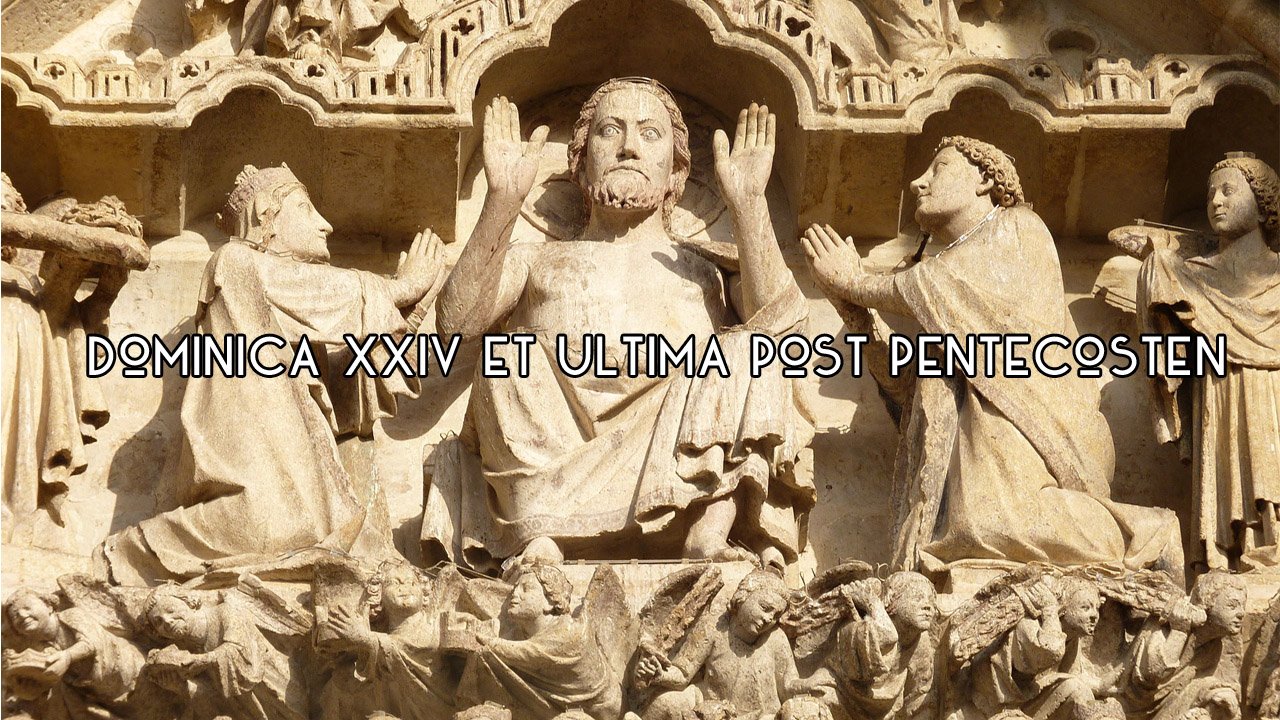
All good things come to their end, with the exception of God’s love and the eternal joy of Heaven. Thus, the Church, in her liturgical wisdom, allows the cycle of the year to come to its own solemn conclusion, so that we may be stirred up again to begin anew. As this series of reflections reaches its close, our gaze is drawn toward the Epistle appointed for the 24th and Final Sunday after Pentecost, Colossians 1:9-14 and the harrowing “end times” Gospel pericope from Matthew 24:15-35. Because of where Easter fell in the calendar this year, we don’t need to use up any of the Sunday’s after Epiphany to fill in between the 23rd Sunday and the Last Sunday (always the 24th even if it isn’t). The end of the liturgical year interlocks with the beginning.
Colossae, a city of Phrygia in Asia Minor (modern-day Turkey) was a Christian community predominantly Gentile in composition (cf. Col 1:21, 27; 2:13). St. Paul did not himself journey there, but entrusted the formation of that church to his collaborators such as Epaphras. While imprisoned in Rome, Paul penned his great letter to them, addressing rising influences that threatened the integrity of the Gospel: remnants of pagan mystery rites, pressures from Judaizers, and the allure of Gnostic systems. The first part of the Letter focuses on doctrine; the second, on the moral life that flows from sound belief. In both the Vetus Ordo’s Epistle for Christ the King (Col 1:12-20) and today’s Epistle (Col 1:9-14), Paul insists that true Christian life bears fruit, deepens knowledge of God, and draws believers out of darkness into the kingdom of the beloved Son.
Bl. Ildefonso Schuster summarizes today’s Epistle with characteristic clarity:
“In today’s Lesson St Paul describes the inexhaustible riches of the Christian ideal, the knowledge of the ways of God, the fruitfulness in good works, the communion of saints in the kingdom of light, and the remission of sins through the blood of the Redeemer. He dwells insistently on the idea that Christianity is life, and, as such, needs development, boldness, energy, so that each member of the Church may, by the influence of divine grace, make daily progress in realizing the life of Christ in all its completeness.”
Paul writes with such confidence because he has heard of the Colossians’ steadfast growth through the ministry of Epaphras. Therefore, “from the day we heard of it, we have not ceased to pray for you,” asking that they “may be filled with the knowledge of his will in all spiritual wisdom and understanding” (Col 1:9). The Apostle prays that they be “strengthened with all power,” endure with patience, give thanks to the Father who has “qualified us to share in the inheritance of the saints in light” and “delivered us from the dominion of darkness.” The eschatological timbre of these lines harmonizes naturally with the final weeks of the liturgical year, when the Mass and Office sound warnings of the end times and consolations for the faithful: death, judgment, Heaven, Hell, the destruction of Jerusalem, the “abomination of desolation,” the shaking of the cosmos, and the coming of the Son of Man in glory.
Today’s Gospel, Matthew 24:15-35, is indeed harrowing. Yet the Church places this terrifying imagery on our lips at the very moment the year draws to a close, that we may contemplate both the end of the world and the Second Coming. Advent, far from being a sentimental prelude to Christmas, is deeply eschatological, centering not only on Christ’s first coming in humility at Bethlehem but His triumphant return in majesty.
Between the readings, the Gradual from Psalm 43 (44) proclaims: “Thou hast saved us from our foes… In God we have boasted continually…” The Alleluia intones Psalm 129 (130), the beloved De profundis: “Out of the depths I cry to thee, O Lord!” These transitional chants often serve as a lyrical bridge between Epistle and Gospel; but today, one can imagine Paul himself singing them in prison with the same fervor with which he and Silas sang hymns at midnight (Acts 16:16-40). The Apostle can exult in the spiritual flourishing of the Colossians even while crying from the depths of his confinement. His captivity becomes a locus of paradoxical freedom, an image of the Christian who remains joyful in tribulation, steadfast in persecution, and unafraid of meeting the Lord either in death or in the final Parousia.
Such supernatural boldness flows from Paul’s exhortation: “bearing fruit in every good work and increasing in the knowledge of God” (Col 1:10). Not “in a couple good works,” but “in omni opera bono fructificantes.” Christians are to be alert for every occasion of grace, every opportunity to magnify God, every moment to manifest Christ’s life within them. Likewise, Paul does not say “be satisfied with your present knowledge of God.” For knowledge of God increases not only through intellectual study of Catholic doctrine but also through the grace-infused works of mercy, wherein the mystery of the divine image in our neighbor is revealed like the veiled radiance that shone on Moses after meeting the Lord in the Tent of Meeting. Faith is both something in which we believe (the content, fides quae) and something by which we believe (the infused virtue, fides qua).
Never has it been more necessary for Catholics to relearn the basics, deepen their grasp of doctrine, and avoid the snares of false teachers regardless of the colors of the trim on their cassocks.
Nowhere is this learning so embodied, nowhere is doctrine so lived, as in sacred liturgical worship, “the perfect ‘good work’,” theologia prima. The disorders we see in the Church today arise largely from a rupture of continuity in both believing and worshipping. All true reform begins in rightly ordered worship; all apostolic action flows back into the Sacrifice. “We are our rites.”
Fittingly, the Collect for this final Sunday expresses this entire spiritual program in compact majesty:
Excita, quaesumus, Domine,
tuorum fidelium voluntates:
ut, divini operis fructum propensius exsequentes;
pietatis tuae remedia maiora percipiant.
This Collect dates to at least the 9th-century Liber sacramentorum Augustodunensis, itself drawing on ancient Gelasian material. Its Latin vocabulary glows with carefully wrought patristic richness. Excita, “arouse, awaken, incite.” Propensius, “more eagerly, more willingly.” Exsequentes, “pursuing, following to the end.” Pietatis tuae, the divine mercy. Remedia maiora, the greater remedies of God’s healing.
A literal rendering is:
Rouse up, we beseech You, O Lord,
the wills of Your faithful:
that, pursuing more earnestly the fruit of the divine work,
they may obtain the more greatly the remedies of Your mercy.
The two comparatives, propensius and maiora, reveal a theological symmetry: the more earnestly we pursue the divine work (which itself is grace operating in us), the more abundantly God grants His healing.
This Collect is the inspiration for the English name “Stir-Up Sunday,” not only from the Latin excita but also from the custom of stirring Christmas pudding on this day. The domestic image charmingly complements the spiritual call: stir up, awaken, rouse the sluggish heart to prepare for both the Nativity and the Second Coming.
Even the venerable Gelasian tradition echoes forward in unexpected ways. Pope Benedict XIV, in Providas Romanorum (1751), quotes a prayer attributed by St. Giuseppe Maria Tomasi to Gelasius, from a Mass contra obloquentes (“against those who rail”):
“Praesta, quaesumus, Domine ut mentium reprobarum non curemus obloquium…”
with its startling petition:
“Cast down, O Lord, by the might of Your right hand, those plotting against the firmament of your completeness; so that iniquity will not lord it over justice, but rather falsity will always be subjected to truth.”
The dogged realism of this prayer resonates with the eschatological vigilance of the final Sunday of the year.
Connections within today’s Mass texts further illuminate the Collect’s imagery. St. Gregory the Great, in his sermon on Matthew 20 (Hom. XL in Evangelia, I, 19, 2), interprets the parable of the workers in the vineyard according to the ages of a man’s life. He contrasts the industrious laborer with the idle man:
“For whoever lives for himself and is sated by his own pleasures of the flesh, is rightly called ‘idle’, because he is not pursuing the fruit of the divine work (quia fructum diuini operis non sectatur).”
Thus the Collect becomes a plea that we not be idle, not content with spiritual minimalism, but stirred up – excita – to pursue the fruit of the divine work with even greater eagerness, especially at the threshold of Advent.
Paul’s admonition to “bear fruit in every good work,” the Collect’s exhortation to pursue the fruit of the divine work, the Secret’s prayer for purification from cupiditates, the Postcommunion’s desire for healing (medicatio), and the Gospel’s warnings of deception and antichrists—these all converge into a final, bracing summons: be vigilant, be fruitful, be ready.
Our earliest Christian ancestors longed for Christ’s return, crying maranatha (“Come, Lord!”). Pius Parsch notes that medieval Christians added a sense of dread, embodied in the Dies Irae: “My prayers are not worthy: but You, Who are good, graciously grant that I be not burned up by the everlasting fire.”
In modern times we lack both longing and fear.
“What is left for us to do?” asks Parsch. His answer is simple and luminous: meditate on the last things, cultivate readiness, fix our gaze upon Christ’s Second Advent, and become rich in good works. The Holy Sacrifice itself is a mystical Second Advent, where judgment and mercy meet: Christ re-presents the judgment He took upon Himself so that we might hear, “Come, blessed of my Father…”
And so, as the liturgical year ends, Johann Evangelist Zollner’s 19th-century Pulpit Orator offers a fitting peroration, impossible to surpass:
“Since the epistles which the Apostles wrote by the assistance and inspiration of the Holy Ghost contain the word of God, as well as the gospels, equal honor is due to both; do not omit then to read them on Sundays and holidays together with the gospels… By so doing, you will belong to the number of those of whom Christ says: ‘Blessed are they who hear the word of God, and keep it.’—Luke 28.”
And so, dear reader, we draw the curtain on this series Colligite Fragmenta. Like the harvest gathered in before the winter frost, our reflections on the last Sundays of the ecclesiastical year have sought to lay up spiritual grain in the storehouse of the soul.
Thus ends the year. Thus begins the new one. Excita… stir up… awaken. The Lord is near.
Get ready.